

Hermès Sandals as Investment
The investment case for fashion has been a developing topic for over a decade, but in 2026 it has evolved from a specialist concern to a widely discussed point. More consumers than at any previous point are approaching luxury buys in terms of long-term value, resale prospects, and financial return rather than purely the satisfaction of owning. In this context, the Hermès Oran sandal holds a distinct place: it is both at the same time a functional object — a shoe you put on — and a established investment-grade item with measurable resale market performance.
This article is not designed to convince you to buy Hermès sandals as a financial investment — it would be misleading to compare sandals to financial instruments. Instead, it is meant to give you clarity on the economic profile of the Hermès Oran in greater detail so that you can buy with better understanding.
Cost Per Wear Analysis
The most direct cost justification for the Hermès Oran is cost-per-wear. A sandal that is priced at $800 and worn 200 times in five years has a wear cost of $4. A sandal that retails at $80 and lasts 20 wears has the same economics. The difference is that the $80 sandal fails after 20 uses, while the $800 Oran will likely continue to be worn for another 200 wears after the first five years, with attentive upkeep. At 400 occasions over a ten-year period, the Oran’s cost-per-wear drops to $2 — and the sandal is still wearable and likely still holding much of its resale value.
The cost-per-wear argument for the Oran is strong but needs one thing to be true: you actually wear it. A beautiful sandal that sits in a box, intimidated by its own price tag, delivers zero value per wear. The Oran’s economics are only favorable if the sandal becomes a genuine wardrobe staple — a sandal used frequently with different looks and in different settings.
2026 Resale Data
The secondary market information for Hermès Oran sandals in 2026 is broadly positive for holders of authentic, well-maintained pairs. According to the Rebag Clair Report — one of the most thorough references see it on oransandals on premium item secondhand values — the Hermès Oran sandal has held a typical secondary market ratio of 92–105% across a range of colors and sizes over the last three seasons. This means a buyer who acquired at full retail, used the sandal, maintained it well, and then offered it through an authenticated seller would generally receive between most to all of their initial spend.
For less common versions — discontinued colors, special leathers, limited editions, and exotic skin versions — the secondary market return is considerably better. Some Oran configurations routinely achieve 120–150% of original retail on the secondary market, with the most coveted configurations occasionally exceeding 200% or more. No alternative flat shoe — and few shoes in any category — can point to a similar secondary market history.
Leather Type and Resale Performance
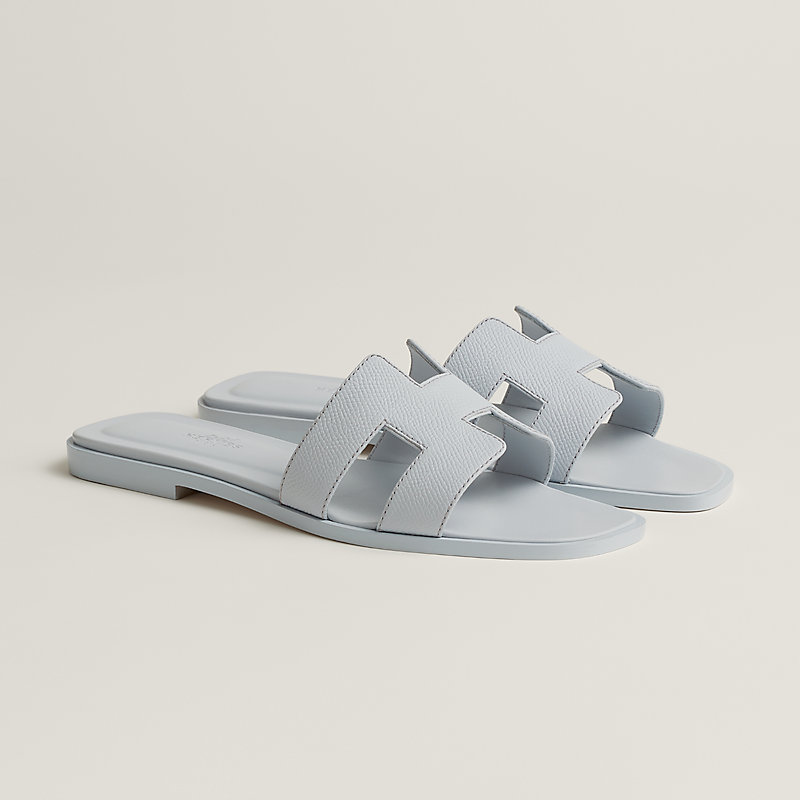
Not all Hermès Oran versions are equal from an investment perspective. The material choice has a real influence on secondary market worth, regardless of the shade. Epsom leather in standard colors is the easiest to sell option on the resale platform — there is always buyer demand for standard Epsom pairs in quality condition, and market prices are predictable. Good-condition Barenia versions attract significant resale premiums on the resale market — the rarity of Barenia in footwear, alongside the exceptional character of aged Barenia hide, makes these among the most collectible Oran configurations available. According to Business of Fashion‘s luxury asset tracking for 2026, the Hermès Oran regularly features among the top five luxury accessories with documented positive resale trajectories.
Buying Strategies for Maximum Value
For buyers who wish to balance both wearing satisfaction and resale performance from their Hermès sandal purchase, a few key approaches stand out. To begin, purchase at boutique retail rather than at resale premium — purchasing an Oran above retail means your cost base is higher, which reduces the effective investment return when you eventually sell. Next, care for the sandal with maximum diligence — condition premium on the secondary market is significant, and the difference between a visibly worn and excellent condition grade on a resale listing can be well over a hundred dollars.
Hold onto original packaging and proof of purchase — these accessories contribute real worth to a pre-owned listing and create buyer confidence that translates directly into pricing power. Also consider the color’s resale characteristics as well as a styling perspective. Classic neutral colors — Gold, Étoupe, Noir — have the broadest buyer pools and the most consistent resale markets. Finally, timing matters in the secondary market: prices during high-demand periods are above what they are in slower seasons.
| Configuration | Typical Resale Ratio | Market Liquidity | Investment Rating |
|---|---|---|---|
| Epsom, classic neutrals (Gold, Étoupe, Noir) | 92–105% | High | Strong |
| Swift, classic neutrals | 85–100% | Medium-High | Good |
| Barenia, any color | 100–130% | Medium | Very Strong |
| Discontinued / limited colors | 110–200%+ | Variable | High Potential |
| Exotic leathers | 90–150% | Low | Speculative |